Everyone thinks they know how to play Blackjack until they’re staring at a hard 16 against a dealer’s 10, the table goes quiet, and panic sets in.
Blackjack isn’t about randomly trying to hit 21. It’s about surviving hands where the math is explicitly stacked against you. Here is exactly how to play your first hand without looking like a tourist or depleteing your bankroll dry on bad instincts.
THE ONE RULE THAT MATTERS
If you only remember one thing before you play: the dealer’s upcard is the most important card on the table. It dictates exactly how reckless or conservative you need to be. Low cards (2-6) favor you. High cards (7-A) mean you are probably going to lose the hand.
The 60-Second Table Walkthrough
If you are sitting down for the first time, this is the shortest path to feeling competent. The dealer won’t wait for you to do mental math.
The Deal
You get two cards. The dealer gets two cards (one usually face up). Add your total. Picture the dealer’s upcard as a “weather forecast” for how miserable this hand will be.
The Threat Assessment
If the dealer is showing a 5 or 6, they are highly likely to bust. You can play conservatively. If they are showing a 10 or Ace, brace for impact. You will need to take risks to compete.
The Decision
You must choose one move: hit, stand, double, split, or (if you’re lucky and the table allows it) surrender. Let the math decide, not your gut.
The Resolution
The dealer plays by strict, unchangeable rules. They have no strategy. They will simply draw cards until they hit 17 or bust. Whoever is closer to 21 wins.
Card Values (And Why Soft Hands Matter)
- 2 through 10 count as their number.
- Face Cards (J, Q, K) count as 10.
- Aces count as 1 or 11.
That last one matters. A hand is “soft” if you can count an Ace as 11 without busting. Why does this matter? Because a Soft 17 (A + 6) is not the same as a Hard 17 (10 + 7). You can hit a Soft 17 completely risk-free. If you draw a 10, the Ace just becomes a 1.
If you stand on a Soft 17, you are leaving money on the table.
THE MYTH
"The goal of Blackjack is to get as close to 21 as possible."
THE REALITY
This is exactly how tourists lose money. The goal of Blackjack is to beat the dealer. If the dealer is showing a 6 (meaning they are highly likely to go over 21), your goal is simply not to bust. You could stand on a 12 and win because the dealer busts. Do not force a 21 if the dealer is probably going to hang themselves.
The “House Edge” Hiding in Plain Sight
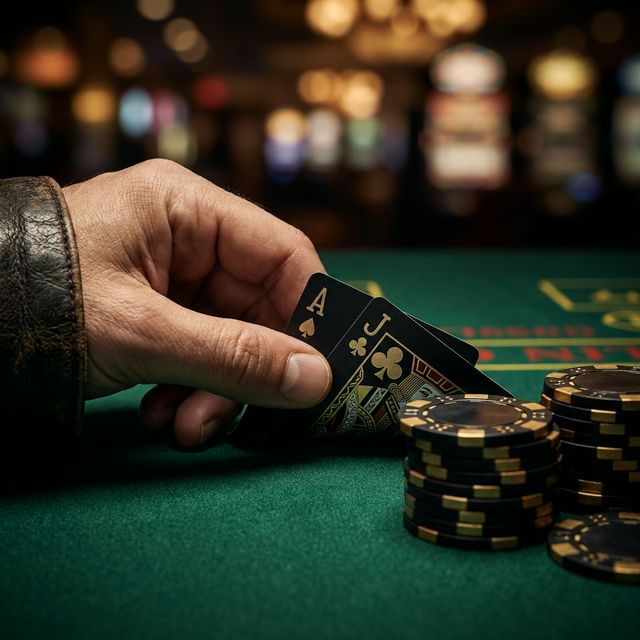
A blackjack is an Ace plus a 10-value card on your first two cards. Historically, getting this pays out at 3:2. That means a $10 bet wins $15.
Today, nearly every casino on the Vegas strip - and many highly unfavorable online sites - have quietly changed this to 6:5. A $10 bet now only pays $12.
It sounds like a minor detail. It isn’t. Playing at a 6:5 table increases the house edge by massive margins. Never play a 6:5 table. Walk away.
The Moves You Can Make
Here is what the buttons on the screen actually mean.
- Hit: Take one more card. You are risking a bust to improve your total.
- Stand: Keep your total and end your turn. You are hoping your current total is enough to survive.
- Double Down: Double your bet size, but you must take exactly one more card, and then your turn ends automatically. (Only do this when you have an advantage, like an 11 against a dealer’s 6).
- Split: If you have a pair (like two 8s), you split them into two separate hands by placing a second, equal bet. (Always split Aces and 8s).
- Surrender: You forfeit half your bet to end the hand immediately. Use this when your hand is statistically weak (like a 16) and the dealer is showing a 10. Half a loss is better than a full loss.
THE INSURANCE MISCONCEPTION
Insurance is a side bet offered when the dealer shows an Ace. It acts as “protection” in case the dealer has a blackjack. Mathematically, it is one of the worst bets in the casino. Do not take insurance. Ignore the prompt.
Read the Fine Print Before You Deposit
If you are playing online, the virtual felt looks the same everywhere. But the underlying math doesn’t. Before you put real money down, open the ‘Info’ tab and check these three things:
- Does Blackjack pay 3:2 or 6:5? (If 6:5, close the tab).
- Does the dealer Hit or Stand on Soft 17? (Standing is better for you).
- Is Surrender allowed? (If yes, it slightly reduces the house edge).
Blackjack isn’t about finding a magical winning streak. It’s about executing a boring, mathematically sound process over and over again, and limiting your exposure when the cards run cold.
If you want the actual mathematical decision map, read our guide on [Basic Strategy Charts: Stop The Overwhelm].
This article is for informational purposes only.